
Mouthwash Can Freshen Your Breath—but Is It Addressing the Real Problem?
A strong mint flavor can make your mouth feel cleaner within seconds. Unfortunately, that fresh sensation does not always mean the underlying source of chronic bad breath has been removed.
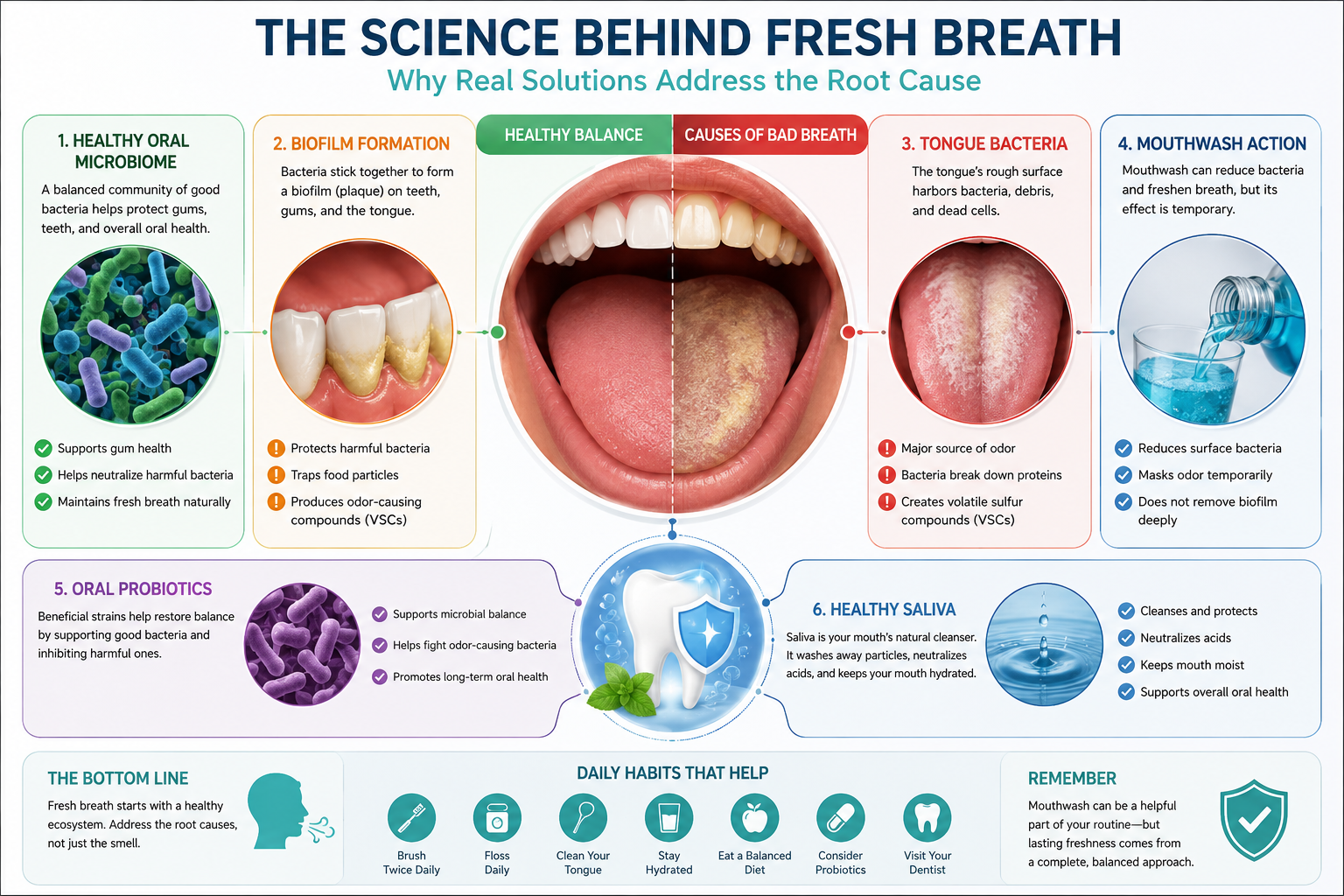
Millions of adults reach for mouthwash whenever they notice an unpleasant taste or worry that their breath may not smell fresh. This habit is understandable. Mouth rinses are convenient, widely available, and often advertised as a fast way to kill germs and control odor. Some therapeutic rinses can be useful parts of an oral care plan, especially when selected for a specific dental need. However, a rinse should not automatically be viewed as a complete treatment for persistent halitosis.
Chronic bad breath frequently begins inside the mouth. Odor-producing bacteria may collect within the coating on the tongue, between teeth, along the gumline, inside periodontal pockets, around dental restorations, or beneath removable appliances. Reduced saliva flow can make the problem worse because saliva normally helps wash away food particles, lubricate oral tissues, and support the mouth’s natural cleansing system.
This explains why someone may rinse in the morning, experience a burst of minty freshness, and notice the odor returning later. The rinse may have changed the smell temporarily without removing enough of the bacterial coating, trapped debris, plaque, or dry-mouth trigger responsible for it. Lasting improvement usually begins by identifying the cause rather than repeatedly covering the symptom.
What Is Chronic Bad Breath?
Bad breath, also known as halitosis, describes an unpleasant odor associated with exhaled air. Nearly everyone experiences temporary breath odor after waking, eating strongly flavored foods, drinking coffee, or going several hours without food or water. These occasional episodes are different from an odor that repeatedly returns despite brushing, flossing, rinsing, or using mints.
Chronic bad breath is not defined simply by having morning breath once in a while. It is a persistent or frequently recurring concern that may be noticed by the individual, a family member, a dental professional, or someone in close conversation. Because people can become accustomed to their own breath, self-assessment is not always reliable.
In many cases, the source is oral. Plaque accumulation, gum inflammation, an untreated cavity, poorly cleaned dentures, food trapped between teeth, tongue coating, smoking, and reduced saliva can all contribute. Less commonly, a dentist may recommend medical evaluation when no clear oral cause is found or when additional symptoms suggest another condition.
Why Mouthwash Often Does Not Solve the Root Cause
Mouthwash is not one single type of product. Cosmetic rinses are mainly designed to create a pleasant taste and temporarily mask odor. Therapeutic rinses may contain active ingredients intended to reduce plaque, control gingivitis, strengthen enamel, or address another defined oral health need. Their usefulness therefore depends on the formulation and the reason they are being used.
Even an antimicrobial rinse may not physically remove a thick coating from the tongue, hardened tartar, debris lodged between teeth, or deposits located beneath the gumline. It also cannot repair a cavity, professionally clean periodontal pockets, correct a poorly fitting dental appliance, or determine why saliva production has decreased.
Another concern is that people may use mouthwash as a substitute for brushing, interdental cleaning, tongue care, hydration, or dental visits. Rinsing can complement these practices, but it does not replace them. When odor keeps returning, using a stronger flavor or rinsing more often may delay the professional evaluation needed to identify the source.
The Oral Microbiome Explained
The mouth contains a diverse community of microorganisms living on the teeth, tongue, gums, cheeks, saliva, and other oral surfaces. This community is commonly called the oral microbiome. Having bacteria in the mouth is normal; the goal of oral care is not to create a completely sterile environment.
Problems may develop when hygiene, diet, smoking, illness, medication, reduced saliva, or other factors allow certain microbial communities and deposits to become more difficult to control. Some bacteria break down proteins from food remnants, saliva, shed cells, and gum fluids. During this process, they can produce volatile compounds associated with unpleasant breath.
A brief rinse may reduce some free-floating organisms or temporarily alter odor, but bacteria attached to protected surfaces can be more persistent. This is one reason a complete routine focuses on physical plaque disruption, cleaning between teeth, tongue hygiene, adequate saliva, and professional care when necessary.
How Oral Biofilm Forms
Oral bacteria do not always exist as isolated organisms floating freely in saliva. They can attach to a surface and become part of a structured, sticky microbial community known as a biofilm. Dental plaque is a familiar example.
Biofilm can form on teeth, around the gumline, between teeth, on dental appliances, and across the textured surface of the tongue. Its structure can shelter microorganisms and help accumulated material remain attached. Swishing liquid around the mouth may contact the surface, but it may not remove the entire deposit.
Mechanical cleaning is therefore essential. Toothbrushing disrupts plaque on accessible tooth surfaces, while floss or another interdental device reaches areas a toothbrush may miss. Professional cleaning is required for hardened calculus and deposits in areas that cannot be safely managed at home.
Why Tongue Bacteria Matter
The top of the tongue contains grooves, papillae, and an uneven surface where microorganisms, food remnants, mucus, proteins, and shed cells can collect. Together, this material may create a visible tongue coating and provide an environment in which odor-associated compounds are produced.
Brushing the teeth without cleaning the tongue may therefore leave a major bacterial reservoir largely undisturbed. Gentle tongue cleaning with an appropriate scraper or toothbrush may help reduce the coating for some people. Pressure should remain light because aggressive scraping can irritate delicate tissue.
Tongue cleaning is not a cure for every case of halitosis. If breath odor continues despite a thorough routine, a dental examination is still important, particularly when there is bleeding, gum swelling, tooth pain, loose teeth, persistent dryness, sores, or an unusual taste.
Why Temporary Freshness Is Not Enough
Mint flavor, cooling ingredients, and fragrance can create an immediate sense of cleanliness. That sensation is valuable when a person wants a quick refresh, but it should not be confused with evidence that plaque, tongue coating, gum inflammation, or dry mouth has been resolved.
A more complete strategy may include brushing twice daily with fluoride toothpaste, cleaning between the teeth, gently cleaning the tongue, drinking enough water, caring for dental appliances, avoiding tobacco, and scheduling regular dental examinations. A dentist can also advise whether a therapeutic rinse is appropriate and which formulation best matches the individual’s needs.
The key lesson is simple: mouthwash can be useful, but chronic bad breath deserves investigation. Treating the source offers a better foundation for lasting oral freshness than repeatedly masking the odor.